
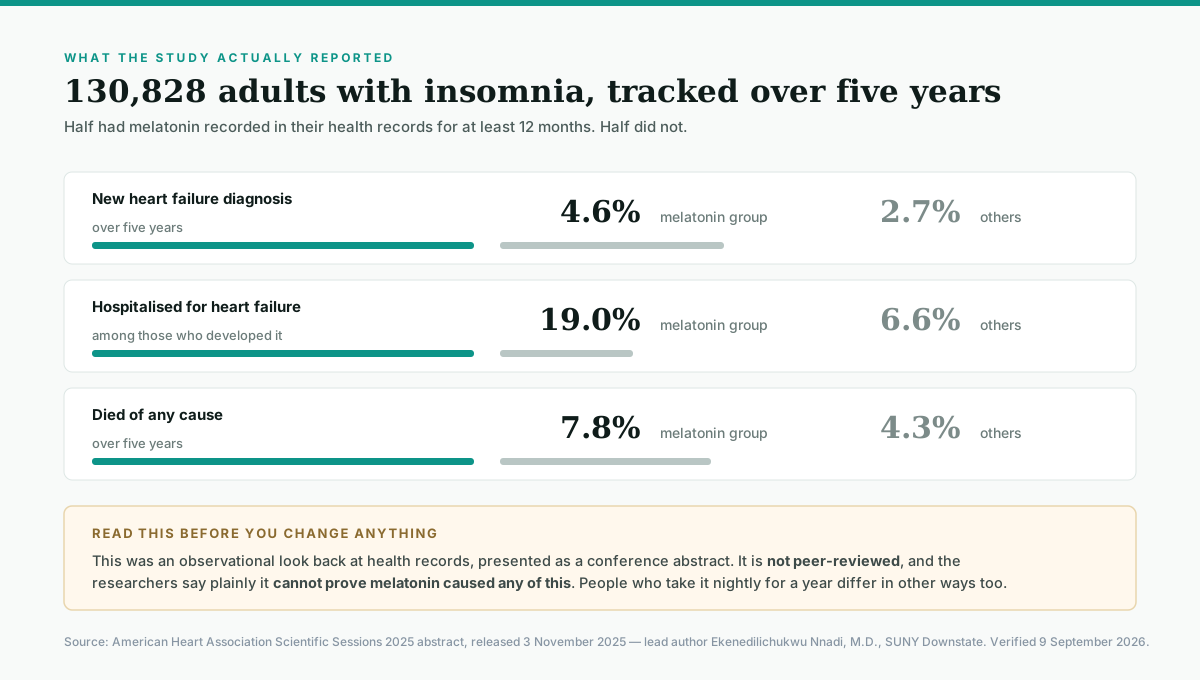
An observational analysis of 130,828 adults with insomnia, released by the American Heart Association on 3 November 2025, reported that those with at least 12 months of melatonin in their health records had a 4.6% rate of new heart failure over five years against 2.7% among matched non-users - roughly 90% higher. It has not been peer-reviewed, it cannot show that melatonin caused anything, and it is still worth understanding rather than ignoring.
The work came from Ekenedilichukwu Nnadi, M.D., chief resident in internal medicine at SUNY Downstate/Kings County Primary Care in Brooklyn, drawing on the TriNetX Global Research Network of electronic health records. Participants averaged 55.7 years old and 61.4% were women. Half - 65,414 people - had long-term melatonin documented; the other half were matched comparisons.
The three numbers
- New heart failure over five years: 4.6% in the melatonin group against 2.7% in the comparison group.
- Hospitalisation for heart failure: 19.0% against 6.6% - which the researchers described as nearly 3.5 times as likely.
- Death from any cause: 7.8% against 4.3%, close to twice as likely.
Those gaps are large enough that they are unlikely to be noise. What they are not is proof of a cause.
Why the design limits what you can conclude
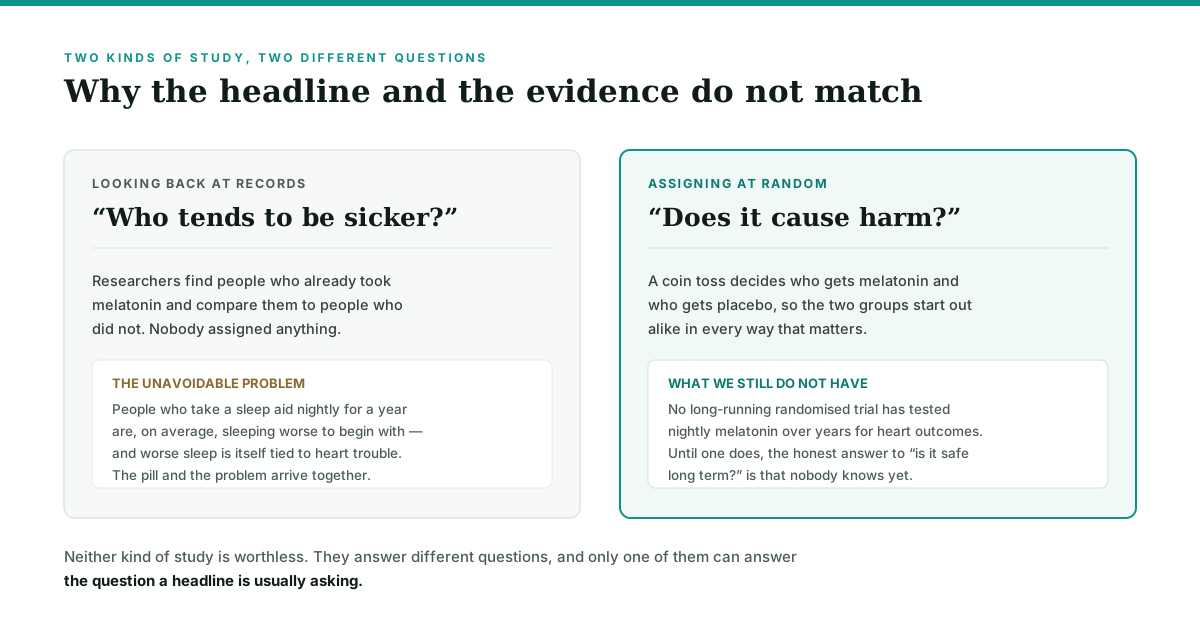
Nobody assigned melatonin to anyone here. Researchers went looking in existing records for people who had already been taking it and compared them to people who had not. That leaves a problem no amount of statistical matching fully removes: a person who takes a sleep aid every night for a year is, on average, sleeping worse than a person who does not - and poor sleep is itself associated with cardiovascular disease. The supplement and the underlying problem travel together.
The authors said as much. They noted the analysis cannot establish cause and effect, and that they lacked information on insomnia severity and on psychiatric conditions - both of which plausibly affect both the decision to take melatonin and the risk of heart trouble.
One more limitation worth knowing if you are American: the analysis excluded over-the-counter users in the United States, because those purchases do not appear in medical records. The people studied had melatonin documented by a clinician. That is not the typical U.S. melatonin user.
What this means for you
If you take melatonin occasionally - a few nights after a long flight, say - this study says essentially nothing about you. It looked at twelve months and longer.
If you have been taking it nightly for a year or more, the reasonable response is a conversation with your doctor at your next appointment, not a decision made tonight from a news story. Stopping abruptly is not obviously safer than continuing, and this report gives no basis for either instruction. We are a review site, not your clinician, and this is precisely the boundary where that distinction matters.
What the finding does justify is a shift in default assumption. Melatonin is sold in supermarkets beside the vitamins, which quietly implies a level of long-term safety evidence that does not actually exist for nightly multi-year use. "Available without a prescription" and "studied for years of continuous use" are separate claims.
What has not been established
No long-running randomised trial has tested nightly melatonin over multiple years for cardiovascular outcomes. Until one does, the honest answer to "is it safe long term?" is that the evidence is not there in either direction.
Dose is unaddressed. The analysis did not distinguish between the doses people took, and over-the-counter melatonin products have repeatedly been found to contain quantities differing substantially from their labels.
Peer review is still pending. Abstracts presented at American Heart Association scientific meetings are not peer-reviewed, and the association describes such findings as preliminary until published in full. That process can change conclusions, and sometimes does.
Common questions
Does melatonin cause heart failure?
This study cannot answer that. It found an association in health records, and the researchers explicitly stated it cannot prove cause and effect. A plausible alternative explanation - that severe insomnia drives both the melatonin use and the heart risk - has not been ruled out.
Should I stop taking melatonin?
That is a question for your doctor, who knows why you started. Nothing in this report supports stopping abruptly on your own.
Is occasional melatonin use affected by this?
The analysis looked at twelve months of continuous documented use and longer. Occasional use falls outside what was studied.
Has this been published in a journal?
Not as of 9 September 2026. It was presented as a conference abstract at the American Heart Association's Scientific Sessions 2025 and released on 3 November 2025.
What are the non-pill options for sleep?
The environmental factors with the most consistent evidence are unglamorous: bedroom temperature, light, and noise. Our reviews of sleep masks, earplugs and sunrise alarms cover the specific products, and none of them require you to swallow anything.
Sources
- American Heart Association newsroom release, 3 November 2025 - "Long-term use of melatonin supplements to support sleep may have negative health effects"
- Abstract presented at American Heart Association Scientific Sessions 2025; lead author Ekenedilichukwu Nnadi, M.D., SUNY Downstate/Kings County Primary Care
- Data source: TriNetX Global Research Network electronic health records
This report is general information, not medical advice. It will be updated if the analysis is published in a peer-reviewed journal. Last verified 9 September 2026.
Community discussion
Enjoyed this story? Share your thoughts below.